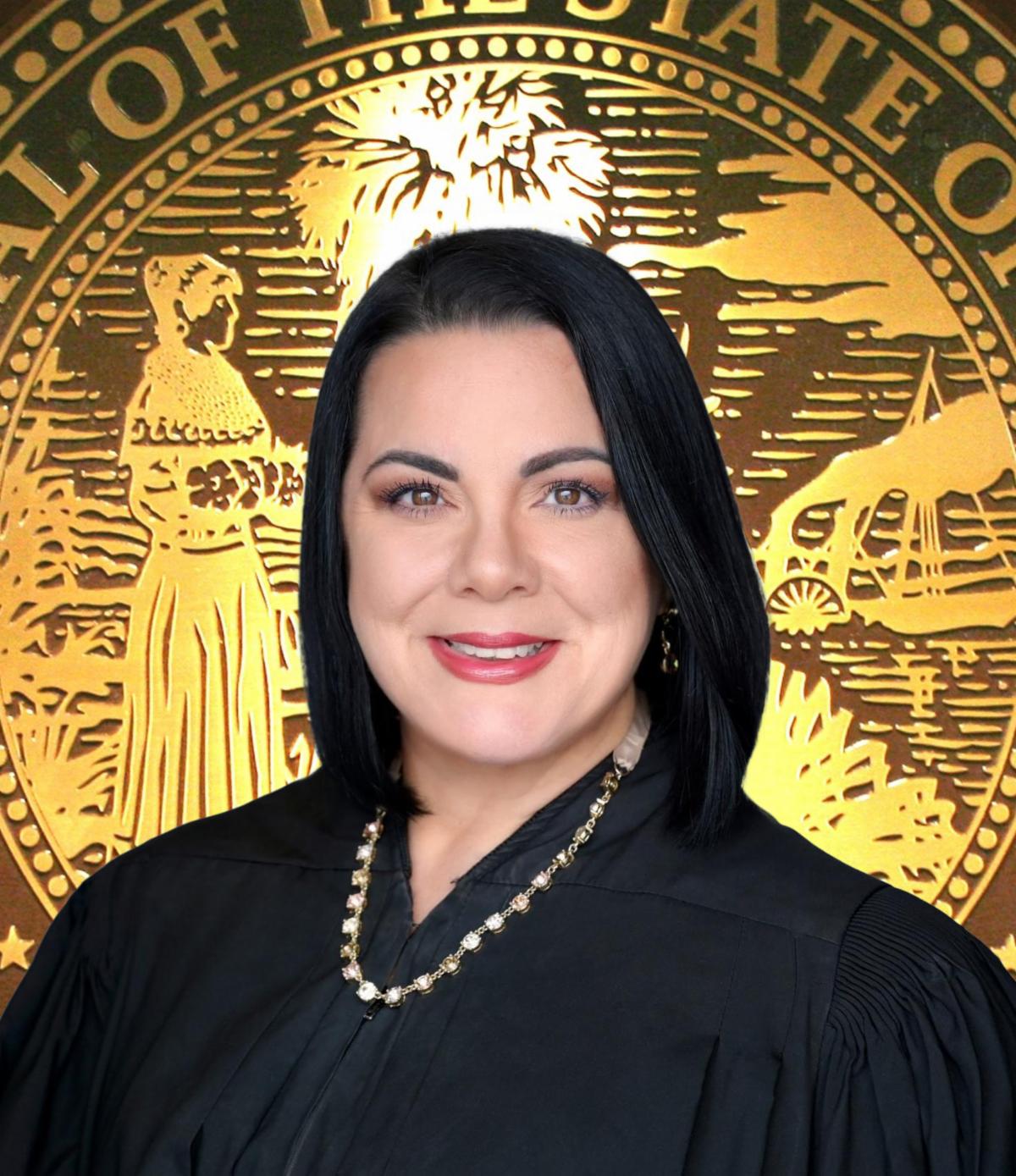
Judge Maria Elena Verde-Yanez is a woman of faith who has faced adversity from a young age but believes in opportunities with accountability and compassion for those entering the criminal justice system through our diversion and therapeutic courts. She credits her family and divine intervention with her rising from humble beginnings to becoming a prosecutor and a judge.
Born in Chicago, Illinois, to Cuban parents who both fled the communist dictatorship, Judge Verde-Yanez grew up witnessing the importance of hard work and perseverance. Her mother came to the U.S. in 1964 at age 14. Three years later, at 17, she met the Judge’s father, and they married. They moved to the Windy City in search of greater opportunity.
At age seven, she, along with her mother and two sisters, moved back to Hialeah to live with her maternal grandparents. Three years later, her mother’s life was cut short as a result of a car accident, and she, at age 10, her sister, aged 12, and the other, aged 5, remained in the custody of her grandparents.
Left with the responsibility of raising three children, her “abuelos” moved the family to Caracas, Venezuela, in 1980. At that time, the country’s economy was booming, and there were better financial opportunities. But seven years later, at age 17, Judge Verde-Yanez returned to Hialeah to pursue her college degree in the States. “I’m a Hialeah girl from a working-class family, and I am proud of that,”
she explains.
“When I came back, I had to relearn English. I had lived and studied in Caracas and did my formal education there. So, I went to Miami-Dade Community College (now MDC) to brush up on the language, but I also had to work to help support the family. I studied and worked full-time. I had to use public transportation since we didn’t have a car.”
Judge Verde-Yanez is the first person in her family to go to college. After earning her associate’s degree, she wanted to go away to college “like the American girls.” She was accepted to Florida State University (FSU) and was able to attend thanks to receiving financial aid. Her grandparents lent her $700 until her financial aid came through, which was a huge sacrifice for the family. Fortunately, her neighbor’s daughter was also going to be starting at FSU. Their adventures as roommates started with a drive up the entire state, with only a paper map and their dreams.
After graduating with a degree in political science and criminology, she came back to Hialeah and worked at Youth Crime Watch of Dade County, a crime prevention organization for students in public schools.
“Since I was 10 years old, I wanted to be a lawyer,” she says. “It may have seemed far-fetched, but success is achieved one accomplishment at a time. I applied to law school but did not get in. So, I started a master’s program at St. Thomas University (STU) and reapplied to STU Law School.”
She didn’t receive a response from the law school. In those days, the process was different. There was no email correspondence, and potential students did not call the school to inquire about admissions after they had applied. You either received a letter of acceptance or you didn’t. But Judge Verde-Yanez called and was told that classes started the following day and that if someone missed the first day, she would be offered that spot.
“I thought that there was no way that anyone would not show up, but in fact, two people didn’t, and I got a call that I had been accepted. I drove over and started law school.”
Judge Verde-Yanez was in the top 25 of her class and went on to be a Certified Legal Intern at the SAO. That is when she decided that she wanted to become a prosecutor. She applied to become an Assistant State Attorney and was hired after being interviewed by State Attorney Katherine Fernandez Rundle.
“It takes a special type of person, someone who both recognizes an individual’s pain as well as their personal responsibilities, to effectively oversee Miami-Dade’s treatment courts,” said State Attorney Katherine Fernandez Rundle. “With her variety of life experiences and perspectives as an Assistant State Attorney, as a defense attorney, and as a young woman struggling to make it through college
and law school, Judge Maria Elena Verde-Yanez has felt so much of the anguish experienced by many of those who have stood before her in court. Her deep empathy and relentless pursuit of justice make her an esteemed and effective member of our judiciary and a valuable asset to the Miami-Dade community."
“I always remember what the State Attorney told us as we came into the office. She started by saying that we (prosecutors) wear the white hats. She also said to ‘always remember that you have the power to file an information, but on the other side stands a person and a family. There is a responsibility that comes along with that ability to file charges.’ Every person deserves dignity when we seek justice, whether it is the victim and their family or the defendant and their family. I felt good about what I did every day.”
“I remember seeing a trial as a young prosecutor. The ASA handling the case was experienced and was able to get a conviction. But after the case, he did not celebrate. He told me that there was a victim who suffered along with their family, and now the family of the defendant will also suffer. There is no reason to celebrate but know that you did your job to seek justice and keep the community
safe.”
Judge Verde-Yanez’s path through the office went from Misdemeanor Court to Felonies and eventually was part of the Narcotics Unit. After four years at SAO, she decided to go into criminal defense. “I did that for a year at a firm and left to start my own law office.”
It was a little office, and my sister was my secretary part-time. When she wasn’t in, I told the potential clients that my secretary was out that day. I only had $2,000 in the bank, and everyone said I needed $20,000 to open my office. The rent was $500 a month, and I figured that I needed to earn enough to cover two months' rent in that first month on my own.” But to her surprise, in her first month, she earned enough to be able to pay the rent for over a year!
I went on to have two employees and had my practice for 10-12 years. I did good work and was the local lawyer that clients could count on. Then in 2010-2011, I decided that I wanted to be a judge.”
“I realized that running for judge is different than being a judge. So, I went and sat in different courtrooms and observed the different judges and how they managed their courtrooms. I saw how they handled themselves and how they made legal decisions. I wanted to be clear as to who I wanted to be as a judge and who I didn’t want to be. As a prosecutor, I learned that everyone deserves to be treated with dignity. That is something that I carry with me today as a judge.
“Then in 2012, there was an open seat, and I ran with an opponent. He was qualified and a good person, so I knew that no matter who won, the people of our community would be well represented. It was a wonderful campaign, and we were always cordial.”
Her opponent had a lot of money for campaigning, but “I had a huge Cuban family! We are working class and do not shy away from getting out there and speaking to people. We did a lot of networking, and we had t-shirts made. For example, my husband had one that said, ‘Vote for my Wife’; my kids had ‘Vote for my Mommy’, and my entire family had one. They were great conversation starters. The
secret sauce is that we were all out there speaking with the people. When all was done, we had pastelitos at home and watched the election results come in. We were all excited to see the result that I had won.”
That moment changed her life, and in 2013, she was sworn in. Judge Verde-Yanez knew that she wanted to hire people who needed a job. So, she hired her Judicial Assistant, who was a single mom at the time and needed employment. She still works with her in that role. “My first Bailiff was a young guy who was living at the church because he couldn’t afford a place. After working with us, he went on to start his own business and is successful. My second bailiff was a female who went on to become a law clerk. And my current bailiff is a young man, who I am sure will use this opportunity to build his future.”
After three years in Criminal Court, followed by seven years in Family Division, then Chief Judge Nushin Sayfie called her to handle Drug Court. “I feel that my experience in criminal and family court really helped me to be able to preside over drug court, which is about all accountability and compassion. We give you the tools and opportunity to change your life, but you have to come to the table and do the work. If not, there are consequences.”
Once she had successfully mastered what was required by the drug court calendar, she saw that she had time available to take on more. “I asked to be busier, so I asked for Mental Health Court as well. I am proud that we intervene there before it becomes more serious. The length of the cases is longer, and they are intense as they require a comprehensive approach. I really want to recognize the entire team that works with me in these courts. They are a wealth of information, and they are the soul of the division.”
As if that wasn’t enough, Judge Verde-Yanez asked to take on the Misdemeanor Mental Health division. “These cases have a high rate of recidivism because the defendants, among other things, tend to experience chronic homelessness.”