For most people, the State Attorney’s Office is a workplace. For Carrie Soubal Jr, it has always been home. Service runs in her family. Her father was a bailiff and three generations of women—Carrie’s mother, her aunt Mary Logan, her older sister Lizette Soubal, and now her own daughter Krystal Revel —have all served the SAO in different capacities.
“I have often said that the broad range of work we do at the State Attorney’s Office can be infectious and Carrie Soubal’s career at the SAO only proves my point,” said State Attorney Katherine Fernandez Rundle. “So many members of the Soubal family have contributed so much to the betterment of our Miami-Dade community because they not only found the work fulfilling but could see first-hand the broad impact of their efforts. Carrie’s many contributions to ensuring the effectiveness of our Mental Health Unit can be best measured, not simply by the number of cases handled but by the number lives pulled out of their own deep, personal darkness.”
Born in 1981—one year before her mother began her SAO career—Carrie grew up in the halls of the office. As a child, her grandmother would schedule her own medical appointments for after she picked up Carrie from school. They would head over to Cedars Hospital which was directly across the street from her mother’s office at SAO.
So, while Abuela was with the doctor, six-year-old Carrie Jr spent those afternoons coloring at a round table. She remembers Chief Assistant State Attorney Stephen K. Talpins walking in, amused at the little girl who kept asking, “Do you have anything for me to do?” He would smile and reply, “Thank you. You can just keep coloring.”
Carrie is a problem solver by nature—she loves puzzles, challenges, and anything that sparks her curiosity. As a child, she loved to read. “When I was little, I was fascinated by the law, and I used to read my mom's law books. Because of this I had a great vocabulary and that's what helped me in the National Spelling Bee Contest.”
She originally dreamed of becoming a lawyer, but in high school she fell in love with computer animation. Life shifted quickly for Carrie her senior year at Barbara Goleman High School when she became pregnant. But even then, the SAO was already part of her path. She had already completed an internship under Maria Diaz, designing pamphlets for the opening of Courthouse Center. She remembers thinking, “I could work here.” Her older sister Lizette was already working in Records Department with Albert Martinez, and the Soubal legacy continued.
After graduating high school, Carrie enrolled at Miami-Dade College and in 2000 she officially joined the SAO in Records, helping with the major project of transitioning all the office’s records from the Graham building to the Bank of America building. “We had a moving company actually move the boxes from one place to another, I unpacked the boxes and did the office and clerical work.”
She later moved to Felony as an LS1 under Miriam Martinez, then to County Court Misdemeanor Crimes at CPP under Elena Reyes. During her time there, Carrie demonstrated her eagerness to learn, her work ethic, self-motivation and her ability to complete herculean tasks in an efficient and accurate manner. One day she was bored and walked into Deputy Chief of County Court Patrick Trese’s office. “I remember him yelling in his office to himself. I peeked in and I asked him if he needed help with anything and he said that he could use some help putting together the appeals
packages. So, he showed me how to do one case. I went ahead and prepared all the ones he had. He was shocked when I came back and with all complete, but I had been bored and I really found it interesting.”
Then in 2007 came an unexpected moment that changed her life and ignited her true passion. The secretary of the SAO Mental Health Unit left suddenly. Carrie was asked to step in temporarily. No one knew the full scope of the job. Carrie dove in anyway. She thrives on figuring things out and doing the hard work.
What she became fascinated with a world that immediately captured her heart: Baker Acts, civil commitments, diversion programs, and helping families in crisis. She worked closely with Mental Health Unit ASA Lourdes Roberts to piece together the responsibilities and absorb everything she could. Carrie even asked to work two desks at once so she could physically stay in the MH unit and learn more. She wanted to understand diversion—not just the process, but the people. The work was complex, emotional, and deeply human—and Carrie felt called to it.
Her passion was personal. She remembered a man who used to walk past her mother’s apartment screaming to himself which taught her an important lesson that she carries with her even to this day. She always assumed he was “crazy” or on drugs. Her parents explained to her: “It’s an illness.” Years later, that same man became one of her Mental Health Court cases. He suffered from schizophrenia and Tourette’s. It was a powerful and profound moment that changed her and gave her a clear perspective into how to best approach the cases and people that came through the Mental Health Unit.
“Everything about the Mental Health Court is very interesting to me not only the cases and the people suffering from mental illness but also the family members who call you many times crying at their wits end trying to get help for their loved one. I remember one case specifically. There was this mother who worked as a receptionist at a doctor's office at Mercy Hospital and her husband was a dermatologist at the same hospital.
Their daughter went to school at Florida State University and came back for spring break. She was completely different, acting wild and was unrecognizable. I fell deep into researching the case and working with the family. In the end we found out that she was smoking synthetic marijuana from a gas station that was causing the psychotic episodes.”
Mental Health Court became more than a job—it became Carrie’s mission. Experiences like these shaped her philosophy: People may not always fully recover from mental illness, but families can learn the signs, prevent crises, and protect their loved ones. She often recommends the book Brain on Fire to families because it explains the experience of mental illness in a relatable way.
“My goal is to help families for the rest of my life. You don't always recuperate from mental illness, but you understand the signs and try to avoid the next crisis. Each crisis has an impact and gets worse than the previous one.” Many who suffer from mental illness self-medicate with drugs and alcohol to deal with their feelings. These substances calm them down and changes the way the person thinks. Self-medication inevitably creates other problems while masking the root cause
issue, mental illness.
Carrie’s work in the Marchman Act Court became another passion. She often supervised outpatient programs herself—visiting service providers, checking on clients, ensuring compliance. She wanted to understand every piece of the system. And she does.
Carrie continued expanding her knowledge and credentials. She earned a Paralegal Certificate in 2010 from the Coral Gables Paralegal Institute. She is also a certified Life Coach specializing in divorce, mental health, relationships, grief, and substance abuse. During the pandemic in 2020, she earned her certification to be a professional guardian.
After becoming a Victim Advocate, then the Mental Health Supervisor, in 2020 Carrie was assigned to supervise the Human Trafficking Unit, this also brought her a passion to management and being able to create a workflow within Human Trafficking and Mental Health that was feasible and fair to all. She didn’t hesitate because when Carrie sees a challenge, she runs toward it. She did this for four years. Then when her mother and pillar of SAO, Carrie Soubal Sr. became ill, she chose to follow her heart and be by her mother’s side for a year and a half. “I am so thankful that the office and the
administration showed me the grace and gave me the ability to take that time to be with her.” This is when Carrie decided to step down from Supervising Human Trafficking and when right back into her passion with the Mental Health division and medical records.
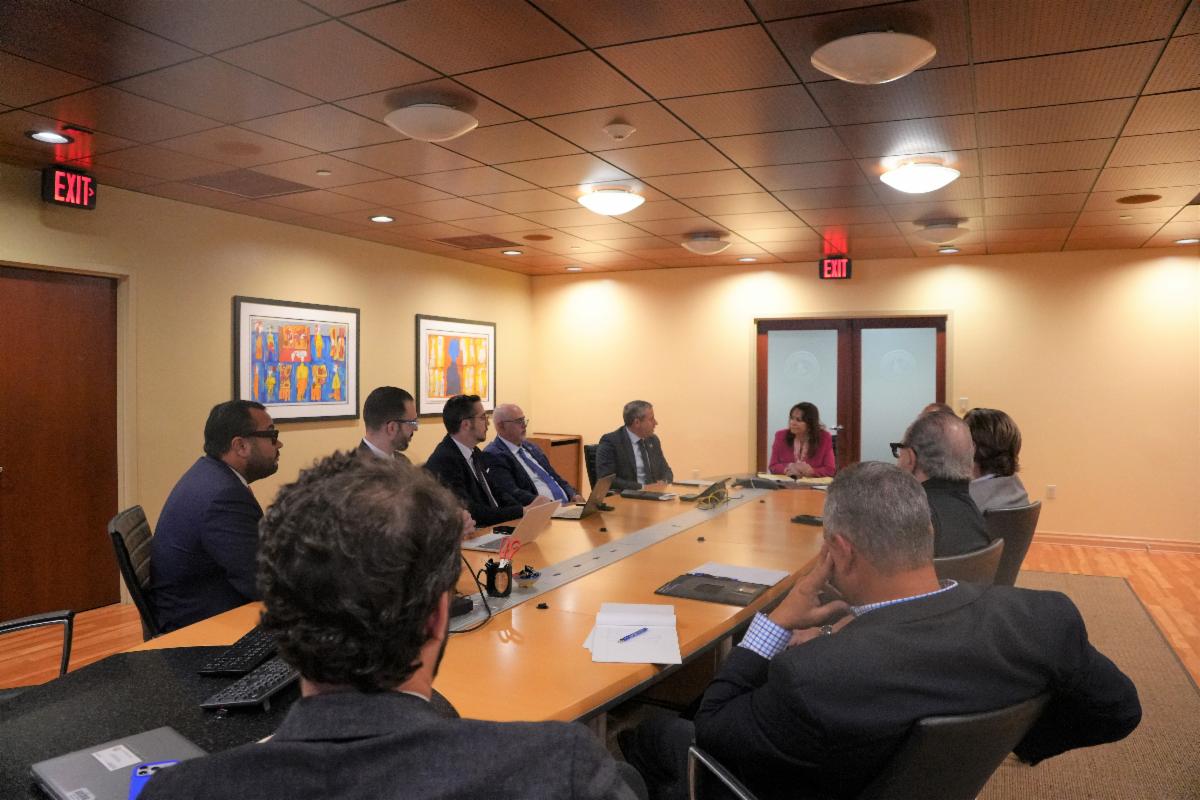
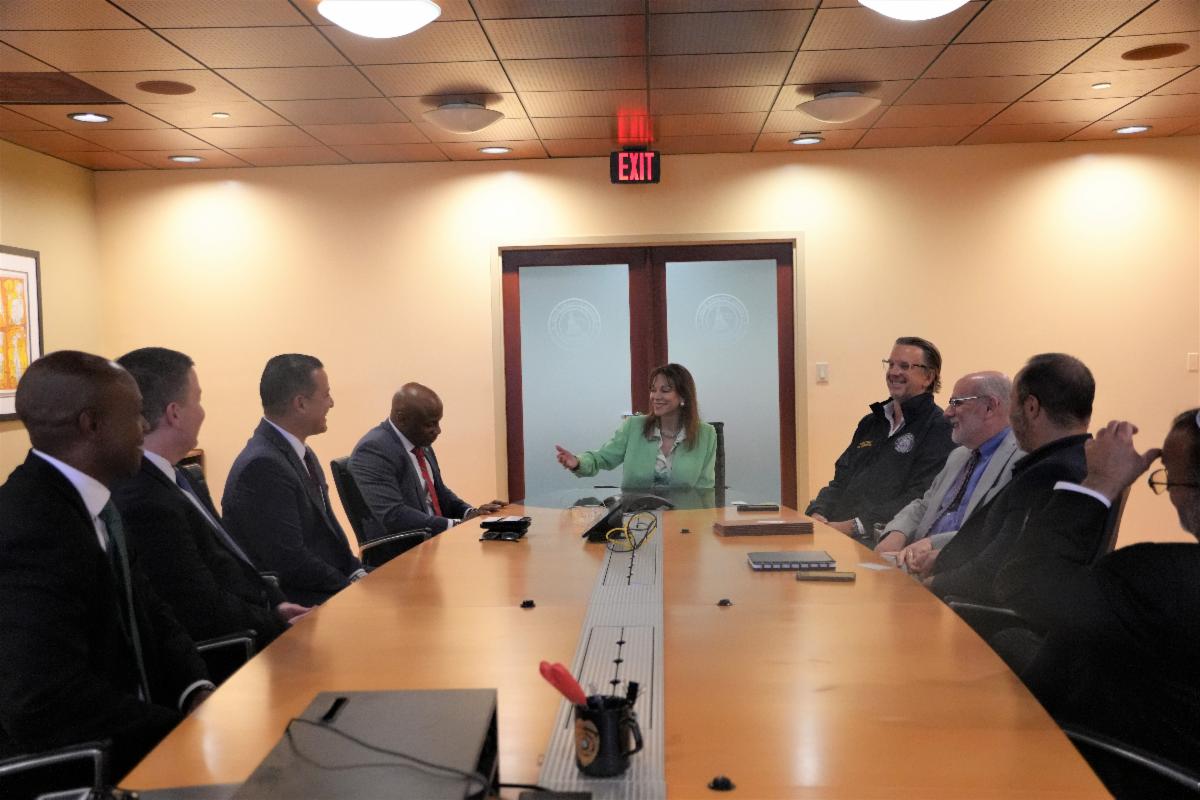
Recently, visitors toured the Human Trafficking building, where the Mental Health Unit is housed. On Carrie’s whiteboard was a detailed breakdown of the diversion process. “One was amazed with how extensive our work and process is in the mental health unit. Then the State Attorney picked up and just beautifully explained everything in a way that was easy to understand and truly indicative of the type of work that we do here. The State Attorney genuinely has a heart for diversion…her heart is filled with passion for it. As a result, according to all the research that I have done, the State
Attorney has shown leadership and has done groundbreaking work in the areas of drug court, mental health court, and veteran's court. A lot of people are copying our diversion programs all over the country.”
“I started working at the SAO because I needed stability after having my two oldest children only 10 months apart. But then what has really kept me here is the mental health unit. I'm so invested in this. It is truly my passion. I can plug into every part of this unit whenever it's needed, I know every aspect of it, and I can even advise attorneys who are pulled in for emergencies to cover. I know all the ins and outs.”
Carrie is the mother of four, grandmother of two and after nearly three decades at the SAO, Carrie still brings the same energy she had as a child coloring in her mother’s office. She hopes to one day be able to retire in Georgia—where, everyone knows, she’ll still find a way to help people. Because for Carrie Soubal Jr, service isn’t just a career. It’s a calling. A legacy. A life’s work.